


 All Blog Articles
Introduction: Why CAFM, CMMS, IWMS and NMS are becoming increasingly important
Companies and public organizations are under growing pressure to operate buildings, technical systems and infrastructure safely, efficiently and in compliance with legal requirements. At the same time, expectations around sustainability, documentation, transparency and cost efficiency continue to rise.
Anyone responsible for managing real estate, maintaining technical equipment or operating complex asset portfolios needs reliable answers to key questions at any time:
- Which assets, buildings and facilities do we operate?
- Where are they located?
- What condition are they in?
- Which inspections, maintenance tasks or corrective measures are due?
- How can compliance with legal and organizational obligations be documented reliably?
This is why digital support for operator responsibility is becoming increasingly important. Systems such as CAFM, CMMS, EAM, IWMS and NMS help organizations structure processes, manage maintenance, meet operator obligations and make relevant data centrally available.
The combination of technical and spatial information is especially important. Buildings, facilities and infrastructure never exist in isolation. They are located in specific rooms, on sites, across properties or along networks. By integrating GIS — Geographic Information Systems — and BIM — Building Information Modeling — technical data can be placed into a spatial context, making operational processes more transparent, efficient and easier to manage.
But what exactly is the difference between CAFM, CMMS, EAM, IWMS and NMS? Which system is suitable for which requirement? And how do these systems work together?
What is CAFM?
CAFM stands for Computer-Aided Facility Management. A CAFM system supports organizations in digitally managing buildings, properties, rooms, facilities, contracts, areas, cleaning processes, energy consumption, maintenance activities and documents. The goal is to map facility management processes centrally, provide structured information and manage operational tasks more efficiently.
Typical CAFM functions include:
- Building and property management
- Space and room management
- Inventory and asset management
- Maintenance management
- Cleaning management
- Contract and document management
- Energy controlling
- Key, reservation and relocation management
- Ticketing, notification and work order management
- Documentation of operator obligations
For operators, this means that information is no longer scattered across Excel files, paper plans, email inboxes or individual departments. Instead, a shared data foundation is created. Tasks can be planned more reliably, responsibilities can be clearly assigned and measures can be documented in a transparent and traceable way.
CAFM is particularly relevant for organizations that need to manage buildings, facilities and operational services in a structured manner — for example municipalities, public administrations, universities, hospitals, industrial companies, property owners and facility management providers.
What is a CMMS?
f CMMS stands for Computerized Maintenance Management System. The focus of a CMMS is maintenance, servicing and technical operations. It helps organizations maintain machinery, technical equipment, infrastructure objects and facilities, reduce failures and make maintenance processes more predictable.
Typical CMMS functions include:
- Management of technical assets and equipment
- Scheduling of recurring maintenance tasks
- Creation and assignment of work orders
- Recording of faults, defects and service requests
- Documentation of completed work
- Spare parts and resource management
- Mobile processing of maintenance orders
- Analysis of downtime, costs and measure status
A CMMS is especially relevant wherever the availability of technical equipment is critical — for example in industry, production, building technology, transport infrastructure, energy supply or municipal infrastructure.
It helps teams move from reactive repairs to planned, preventive and condition-based maintenance. In a facility management context, CMMS and CAFM often overlap. Many CAFM solutions include maintenance functions, while some CMMS solutions also manage building, room or asset data.
What is EAM?
EAM stands for Enterprise Asset Management. EAM systems focus on the management of physical assets throughout their entire lifecycle — from planning and procurement to operation, maintenance, modernization, replacement or decommissioning.
The focus is not only on individual maintenance tasks, but on the strategic management of large asset portfolios. These may include production plants, network infrastructure, technical systems, vehicle fleets, machinery, supply systems or complex infrastructure components.
Typical EAM functions include:
- Strategic asset management
- Lifecycle management
- Condition and risk assessment
- Investment and renewal planning
- Cost and performance analysis
- Maintenance strategy management
- Integration with ERP, finance and procurement systems
- Compliance and governance support
EAM is often used by organizations that operate a large number of critical, cost-intensive or long-lived assets. This includes utilities, industrial companies, transport companies, large property owners and infrastructure operators.
Unlike a CMMS, EAM goes beyond operational maintenance. It does not only answer the question: “Which maintenance task is due?” It also helps answer strategic questions such as:
- Which investment is worthwhile?
- What risk does the condition of an asset pose?
- When is renewal more economical than repair?
- How can asset performance, cost and lifecycle be optimized?
For EAM to be effective, reliable data from operational systems is essential. CAFM and CMMS solutions provide an important foundation by delivering asset information, maintenance histories, status data, costs, documents and spatial references.
What is an IWMS?
IWMS stands for Integrated Workplace Management System. While CAFM traditionally focuses on technical and infrastructural facility management, IWMS addresses broader strategic real estate, workplace and portfolio management requirements.
Typical IWMS areas include:
- Real estate and portfolio management
- Space and workplace management
- Occupancy and relocation management
- Maintenance and service processes
- Sustainability and energy management
- Lease, contract and cost management
- Workplace experience and reservation processes
- Reporting and management dashboards
IWMS is particularly relevant for organizations with large, distributed real estate portfolios or complex workplace models. This includes companies with hybrid work concepts, public administrations, universities, operators of large sites and organizations with high requirements for space efficiency and usage analysis.
The distinction between CAFM and IWMS is not always clear-cut. Modern CAFM platforms are increasingly evolving into integrated, modular solutions. At the same time, IWMS platforms often include classic CAFM functions. In practice, the right system depends less on the label and more on the processes, data and strategic goals an organization wants to support.
What is an NMS?
An NMS — Network Management System — supports the operation, monitoring and optimization of complex network infrastructures, such as electricity, water, gas or telecommunications networks.
Typical NMS functions include:
- Network modeling and documentation
- GIS-based network visualization
- Monitoring and condition management of networks
- Fault and outage management
- Analysis of network relationships and connectivity
- Planning and optimization of network structures
- Support for operational network and field service processes
The focus is on network objects such as lines, cables, transformers, pipes, stations or connection points, as well as their spatial and topological relationships. This makes it possible to visualize network structures, analyze faults faster and manage operational processes more efficiently.
NMS overlaps with CMMS and EAM particularly in the maintenance, servicing and strategic management of network-related assets. For utilities and infrastructure operators, the combination of network documentation, maintenance processes and asset lifecycle management is especially valuable.
Excursus: What is a BMS/BAS?
Another important technical term in this context is BMS/BAS — Building Management System or Building Automation System. These systems are used to monitor and control technical building systems such as HVAC, lighting, security technology or building automation components.
BMS and BAS solutions provide valuable operational data for CAFM and CMMS processes. They can also support EAM by supplying information that helps optimize technical building systems over the long term. For example, sensor data, operating states or consumption values can contribute to better maintenance planning, energy optimization and lifecycle decisions.
Key Differences Between CAFM, CMMS, EAM, IWMS, and NMS
| System | Main Focus | User groups | Central question | Areas of application |
| IWMS | Facility management, buildings, areas, properties, operational FM processes | Facility managers, building management, technical services, municipal operators, real estate management | How do we manage and operate buildings, space, facilities and services efficiently and verifiably? | Building Management, Space Management, Operator Duties, Cleaning, Contracts, Energy, Maintenance |
| CMMS | Maintenance, servicing, work orders, technical equipment | Maintenance teams, technicians, operations management, service organizations | Which maintenance or repair needs to be carried out when, where and by whom? | Maintenance planning, fault management, technical operations management, mobile maintenance |
| EAM | Strategic asset management over the life cycle | Asset Manager, Technical Management, Controlling, Infrastructure Operator, Management | How do we optimize the value, risk, cost and lifespan of our assets? | Lifecycle planning, investments, risk management, performance, strategic maintenance |
| IWMS | Integrated real estate, workplace and portfolio management | Real Estate, Workplace Management, Facility Management, HR, Finance, Management | How do we manage real estate, jobs, space, services and costs in an integrated way? | Workplace Management, Space Optimization, Portfolio Management, Reservation, Sustainability |
| NMS | Operation, monitoring and optimization of network infrastructures | Network operators, utilities, control centers, GIS teams, network planners, field operations | How do we monitor, analyze and operate complex network infrastructures? | Network management for electricity, water, gas and telecommunications, network visualization, fault management, network analyses |
In practice, CAFM, CMMS, EAM, IWMS and NMS rarely operate as completely isolated systems. Together, they form a digital system landscape for managing buildings, facilities, assets and infrastructure. The decisive success factor is integration.
When systems exchange data, a continuous flow of information is created: a fault is recorded on an object, located spatially, converted into a work order, processed in the field, documented digitally and later used for reporting, compliance evidence or strategic investment decisions.
How CAFM, CMMS, EAM, IWMS and NMS support operator responsibility
Operator responsibility means that organizations are accountable for the safe, legally compliant and orderly operation of their buildings, facilities and infrastructure. This includes identifying risks, carrying out inspections and maintenance on time, documenting defects, tracking corrective measures and being able to prove that necessary obligations have been fulfilled.
Typical challenges include:
- Incomplete or outdated inventory data
- Scattered documents and evidence
- Unclear responsibilities
- Lack of transparency around inspection and maintenance deadlines
- Media disruptions between paper, Excel, email and specialist systems
- Complex communication with internal and external service providers
- Difficult evidence provision during audits, claims or official inspections
- Lack of spatial overview of facilities, areas, defects or risks
Digital systems such as CAFM, CMMS, EAM, IWMS and NMS help organizations implement operator responsibility in a structured, transparent and efficient way.
Transparency about assets and obligations: All relevant buildings, systems, technical components, network objects and assets can be recorded centrally and linked with associated information. Responsibilities, inspection intervals, maintenance cycles, documents and legal obligations can be assigned clearly. This creates a reliable data foundation for day-to-day operations as well as for audits, reporting and strategic decision-making.
Automated maintenance and testing processes: Digital systems support operational implementation by automatically scheduling maintenance appointments, monitoring inspection intervals, triggering reminders and escalations, and managing work orders. This significantly reduces the risk of missed inspections, delayed maintenance or undocumented corrective measures.
Traceable documentation: All activities can be documented digitally — from planning and assignment to execution and completion. Organizations can prove when a measure was carried out, who was responsible, what results were documented and which follow-up actions were initiated. As a result, operator responsibility is transformed from a reactive search for documents into a proactively managed, transparent and audit-ready process.
Why operator responsibility needs a spatial context
The spatial component is often underestimated when it comes to digitally securing operator responsibility. A deadline or inspection interval alone is not enough if it is unclear where the relevant asset is located, which room, site, network section or area is affected, and which other facilities, risks or processes are connected to it.
This is where GIS and BIM create significant added value. BIM provides detailed building models and object information. GIS expands the perspective to properties, outdoor areas, infrastructure, networks and spatial relationships. Together, they make it possible to manage technical information not only as data, but in the right spatial and operational context.
This helps organizations answer questions such as:
- Where exactly is the affected asset located?
- Which rooms, buildings, plots or network sections are connected to it?
- Which inspections or maintenance tasks are due in a specific area?
- Where are defects, risks or recurring issues concentrated?
- Which assets are affected by a construction measure, outage or operational change?
By combining technical, operational and spatial data, organizations gain a more complete view of their responsibilities — and can act faster, more transparently and with greater confidence.
Request a free consultation now
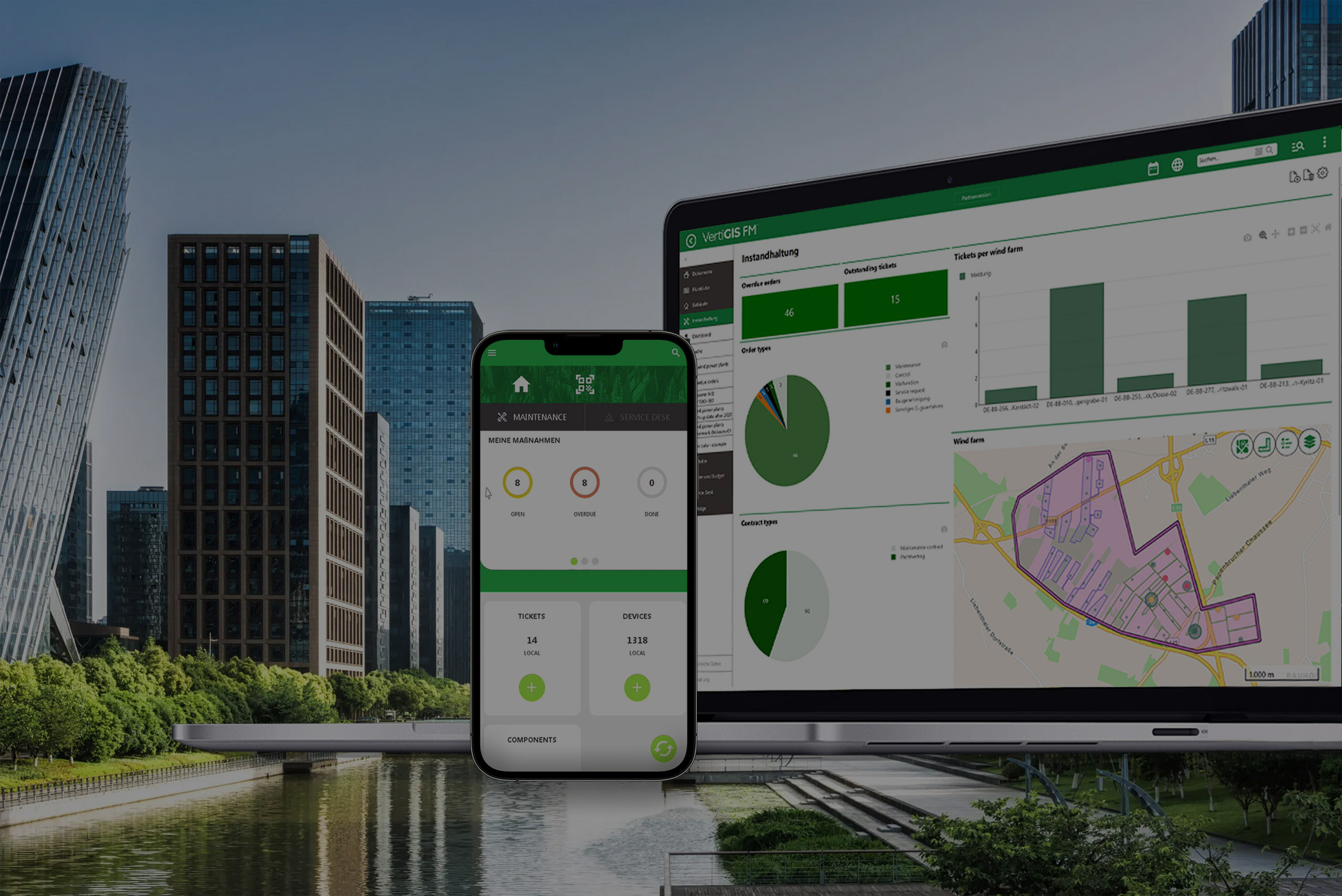
Are you planning to implement a CAFM, CMMS, EAM, IWMS or NMS solution? With VertiGIS FM and VertiGIS Networks, we offer modern, integrated solution platforms for building, asset and network management — including powerful GIS and BIM integration.
Benefit from central data, transparent processes and a digital foundation for fulfilling your operator responsibilities securely and efficiently.
With many years of project and industry experience, we support you in identifying the right system landscape for your requirements, integrating existing data and processes in a meaningful way, and digitally securing your operator obligations step by step — from strategy to implementation.
Get a non-binding consultation now
All Blog Articles