


 All Blog Articles
Written by Drew Millen
Chief Technology Officer at VertiGIS

.
.
Empowering more users to make better decisions by reducing complexity and increasing organizational agility
Executive Summary:
AI is reshaping geospatial operations, but success depends on more than advanced technology. VertiGIS Neo solutions combine AI-enabled workflows, trusted spatial data, and modern cloud-based solutions to help utilities, telecoms, governments, and infrastructure organizations make faster, more informed decisions. By making geospatial intelligence accessible through natural-language interactions and intelligent automation, VertiGIS Neo solutions reduce complexity while maintaining governance and trust. Backed by strong data quality foundations, VertiGIS Neo helps organizations turn data into action today while preparing for the evolving demands of the future.
The Real Question Facing AI in Geospatial Operations
Artificial intelligence has quickly become the dominant conversation in enterprise technology. Every organization is evaluating how AI can improve productivity, automate work, and accelerate decision-making. Yet in geospatial and infrastructure-intensive industries, the discussion is evolving beyond the excitement of what AI could do and toward a more important question.
How do we turn AI into practical, trustworthy outcomes that solve real operational challenges?
At VertiGIS, we believe the future of AI in geospatial applications is not about replacing people with technology. It is about empowering individuals with better tools, better information, and greater confidence in the decisions they make every day.
Trust is a critical part of that vision. As organizations explore increasingly sophisticated AI and agentic technologies, human expertise must remain at the center of decision-making. AI should augment judgment, not replace it. Effective AI systems depend on reliable, quality-controlled data, transparent processes, and human oversight to ensure recommendations are accurate, accountable, and aligned with operational goals.
This philosophy is at the heart of our AI strategy and the continued evolution of VertiGIS Neo solutions.
As AI-enabled applications designed for utilities, telecommunications providers, government agencies, and other asset-intensive organizations, VertiGIS Neo solutions are purpose-built to deliver the capabilities the industry needs today while establishing a trusted foundation for the future. By combining authoritative data, intelligent workflows, human-in-the-loop decision support, and practical AI experiences, VertiGIS Neo helps organizations move from information to action with greater confidence, efficiency, and control.
The Industry Doesn’t Need More AI Hype. It Needs Results
For years, the geospatial industry has discussed AI’s transformative potential. Today, the question is no longer whether AI will become part of operational workflows, because it already has. The real challenge is moving AI initiatives beyond pilot projects. Many organizations face the same barriers:
- Fragmented data
- Technical complexity
- Governance concerns
- Difficulty proving measurable business value
- Reliable outputs
In regulated industries, these barriers are even more serious. Utilities, telecoms, and public-sector organizations cannot depend on systems that produce outputs they cannot fully understand or validate. Decisions tied to critical infrastructure, compliance, and public services require a much higher level of trust.
Success will not come from deploying the most advanced model. It will come from implementing AI that is:
- Practical
- Explainable
- Embedded directly into operational workflows
That is where our strategy begins.
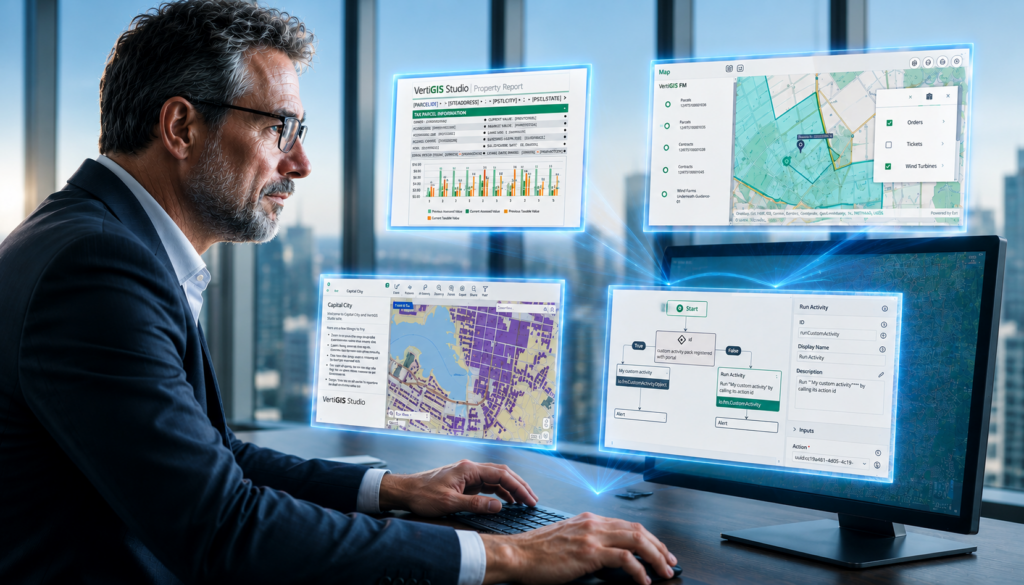
Democratizing Geospatial Intelligence
One of the greatest opportunities for AI is its ability to make sophisticated geospatial capabilities available to far more people.
Historically, many organizations have relied on GIS specialists to perform complex spatial analysis, build workflows, create tools, and extract insights from data. These teams provide tremendous value, but they can also become bottlenecks as demand for geospatial intelligence continues to grow.
AI changes that equation.
The emergence of large language models has fundamentally transformed how people interact with software. Instead of navigating complex interfaces or learning specialized technical skills, users can increasingly describe what they want to accomplish in natural language.
VertiGIS Neo solutions embrace this shift.
Our vision is not to create more GIS specialists. It is to put geospatial expertise into the hands of everyone who needs it by providing:
- AI assistants that enable users to interact with spatial data using natural language rather than complex GIS tools.
- Domain experts who can create tools and workflows without requiring deep technical or programming expertise.
- Field supervisors, planners, asset managers, and operations teams that are able to access information more quickly and act with greater independence.
- Organizational benefits from faster decision-making and shorter implementation cycles.
- Teams with intelligent tools that make them less dependent on scarce GIS and technical resources.
- Greater self-service capabilities to drive agility and responsiveness across the enterprise.
Most importantly, this approach allows expertise to remain where it belongs: with the people closest to the operational challenge.
Building AI Into Workflows, Not Around Them
A common misconception is that AI should exist as a separate tool or standalone application.
Our approach is different.
We believe AI is most effective when it is embedded directly into the workflows where work already happens. VertiGIS AI capabilities are designed around a workflow-first model that helps organizations reduce manual effort, improve consistency, and accelerate delivery without sacrificing governance or control.
Today, these capabilities are already helping organizations:
- Automate document and invoice processing.
- Generate intelligent inspection checklists.
- Accelerate application configuration and deployment.
- Improve troubleshooting and workflow design.
- Support field operations through AI-assisted image extraction processes.
- Reduce repetitive administrative work.
The objective is simple: allow employees to spend less time managing information and more time acting on it. That is where productivity gains are realized and where meaningful ROI begins to emerge.
Trust Is the Defining Requirement for AI
As AI adoption accelerates, trust is becoming the industry’s most valuable differentiator.
Organizations operating critical infrastructure cannot afford unreliable data, opaque decision-making, or uncontrolled AI outputs. They need systems that support governance, transparency, and human oversight.
At VertiGIS, we have made trusted AI a foundational principle of our strategy.
Our AI capabilities are designed to support human-in-the-loop workflows, ensuring that people remain responsible for critical decisions while benefiting from intelligent automation and assistance. Governance is built into the application experience rather than added as an afterthought. AI actions remain visible, reviewable, and accountable.
This approach reflects a broader reality: organizations do not trust AI because it is sophisticated. They trust AI because it is predictable, explainable, and aligned with their operational requirements.
AI Is Only as Good as the Data Behind It
Perhaps the most important lesson emerging from the AI era is that artificial intelligence does not solve data-quality issues.
It amplifies them.
Poor data quality leads to poor AI outcomes. Inaccurate, incomplete, or inconsistent information produces unreliable insights regardless of the sophistication of the underlying model.
That is why the VertiGIS AI strategy places data quality at the center of the conversation.
By integrating advanced data quality and governance capabilities, VertiGIS Neo solutions help organizations ensure that data is accurate, validated, structured, and ready for operational use before it enters AI-driven workflows. At the same time, outputs can be governed and validated before becoming part of critical business processes.
The result is a virtuous cycle:
- Trusted data supports more reliable AI.
- More reliable AI produces better insights.
- Better insights enable better decisions.
- Better decisions drive better outcomes.
For asset-intensive industries, this foundation is essential.
Preparing Organizations for the Next Generation of Geospatial Operations
The future of geospatial technology will be shaped by several converging trends: increased cloud adoption, expanding mobile workforces, modern network management platforms, and growing expectations around AI-driven productivity. Organizations need solutions that help them navigate all of these shifts simultaneously.
VertiGIS Neo is built with this future in mind.
By combining cloud-ready architecture, modern mobile capabilities, trusted data foundations, and AI-enabled workflows, VertiGIS Neo provides a platform that evolves alongside the needs of our customers. It supports organizations as they modernize today while creating the flexibility required for tomorrow’s innovations.
The organizations that gain the greatest advantage from AI will not necessarily be the fastest adopters. They will be the ones that adopt it thoughtfully, with the right governance, the right data, and the right operational foundations.
The future belongs to organizations that can turn data into intelligence, intelligence into decisions, and decisions into action. VertiGIS Neo is designed to help them do exactly that, with AI that is practical, trusted, and built for the real-world challenges of modern geospatial operations.
All Blog Articles